
There are places in Costa Rica where rain is more than a weather event—it is the force that shapes the entire landscape.
In the country’s high mountains, clouds drift slowly across steep slopes, moisture lingers on every leaf, and streams seem to emerge from every corner of the forest. Water is never far away. It falls as rain, gathers as mist, condenses on branches, seeps into deep volcanic soils, and begins a journey that will eventually supply rivers, waterfalls, wetlands, and communities hundreds of meters below.
This is the Lower Montane Rain Forest, one of Costa Rica’s most humid and ecologically significant life zones.
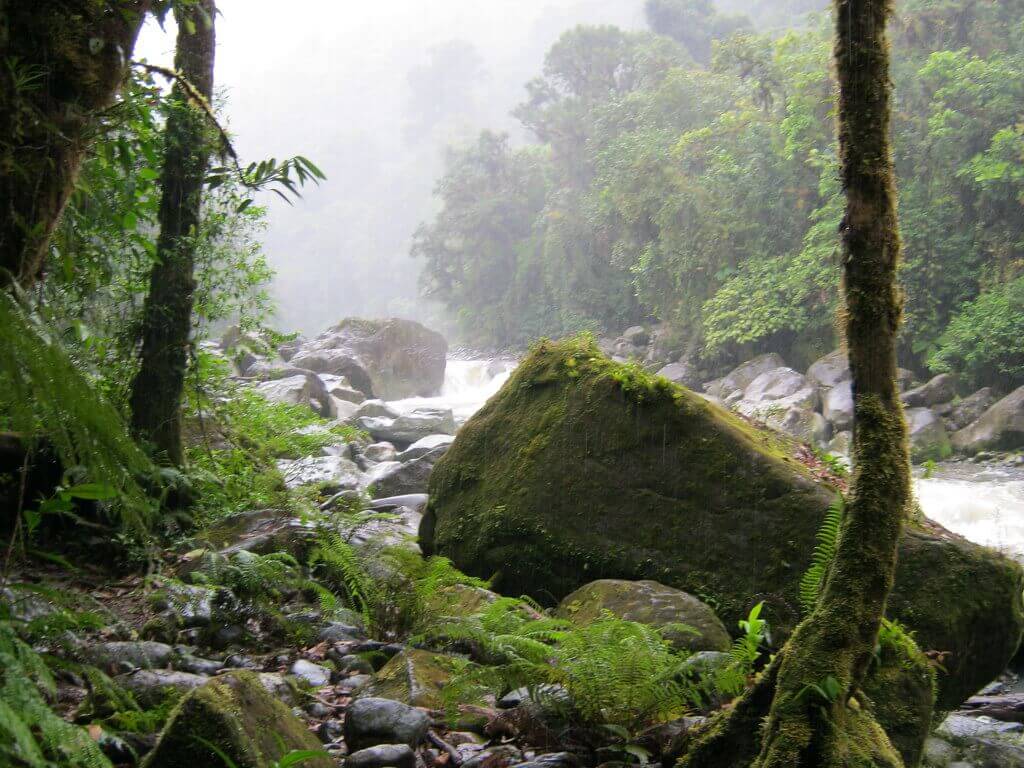
While visitors often admire its moss-covered trees and cool mountain climate, the true story of this ecosystem is not written by the forest itself—it is written by water. Every plant, every stream, and every living organism reflects the extraordinary influence of moisture in an environment where rainfall shapes both the landscape and the life it supports.
Located between approximately 1,800 and 2,800 meters above sea level, the Lower Montane Rain Forest occupies some of Costa Rica’s steepest mountain slopes. Here, moist air carried inland from both the Caribbean and Pacific rises against the country’s mountain ranges, cools rapidly, and releases enormous amounts of rainfall.
Unlike lower forests where sunshine often dominates part of the day, moisture remains a nearly permanent presence.
Clouds move through the canopy, fine mist settles over the vegetation, and rainfall is frequent throughout the year. Even during brief breaks in the weather, water continues to drip from leaves and branches long after the rain has stopped.
This constant cycle of precipitation creates one of the most stable and productive mountain environments in Costa Rica.
One of the most remarkable characteristics of this ecosystem is the way it captures, stores, and releases water.
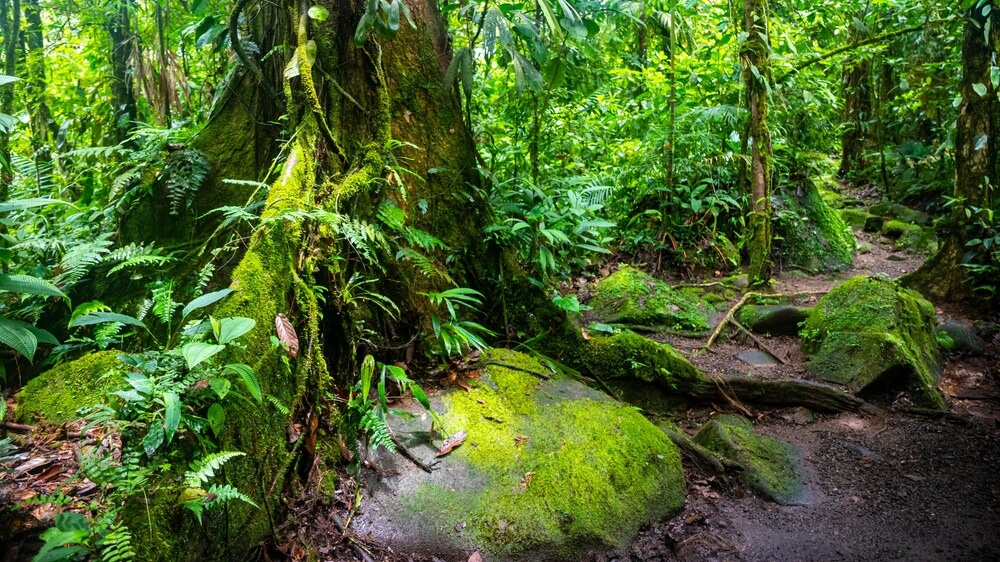
The forest canopy intercepts rainfall before it reaches the ground. Mosses absorb moisture like natural sponges, while layers of organic material covering the forest floor slow the movement of water through the soil.
Rather than rushing downhill, rain gradually filters into underground aquifers and mountain springs.
These natural processes reduce erosion, stabilize steep slopes, and regulate the flow of rivers throughout the year.
In many ways, the Lower Montane Rain Forest functions as a living water reservoir, quietly providing one of Costa Rica’s most valuable natural resources.
Because moisture is so abundant, life extends far beyond the soil.
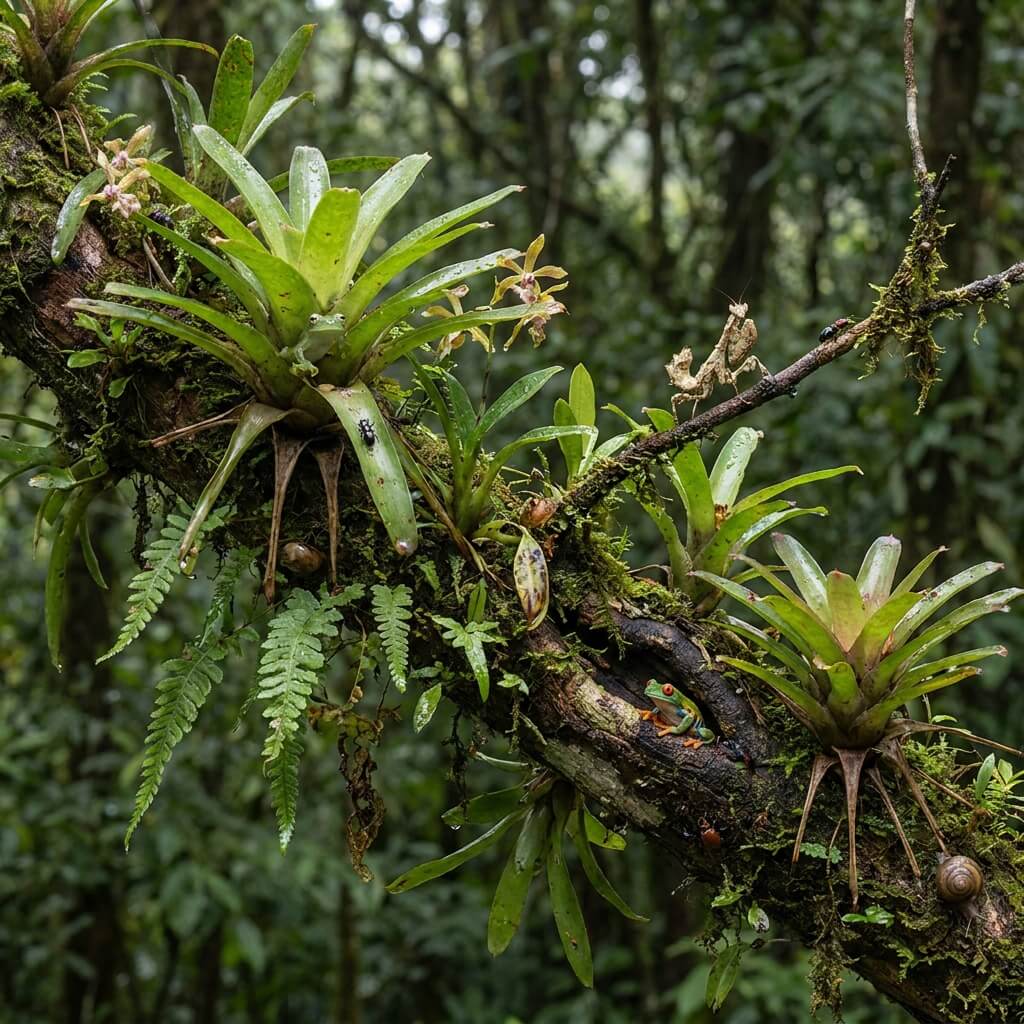
Tree trunks become living gardens where mosses, lichens, orchids, bromeliads, liverworts, and delicate ferns grow side by side. Fallen branches quickly disappear beneath blankets of vegetation, while fungi recycle nutrients at a surprisingly slow pace due to the cool temperatures.
Even the oldest trees support entire communities of organisms.
A single branch may host dozens of plant species, tiny invertebrates, amphibians seeking shelter from predators, and insects searching for moisture-rich microhabitats.
The forest is not simply made of trees—it is composed of countless ecosystems stacked upon one another.
This remarkable vertical complexity allows an extraordinary number of species to coexist within a relatively small area.
Unlike Costa Rica’s tropical lowlands, wildlife here is often more discreet.
Animals have adapted to cooler temperatures, dense vegetation, and constantly changing weather conditions. Instead of relying on speed or large open spaces, many species depend on camouflage, patience, and specialized habitats.
Mountain birds move quietly through the canopy searching for insects, berries, and nectar. Small mammals travel beneath dense vegetation, while salamanders and frogs thrive in the permanently moist leaf litter.
Many invertebrates spend their entire lives among moss-covered trunks or within decomposing logs, rarely venturing into open areas.
For visitors, discovering wildlife in this ecosystem often becomes an exercise in observation rather than chance.
The longer you remain still, the more the forest begins to reveal itself.
Some of Costa Rica’s finest examples of this ecosystem are protected within the country’s mountain parks and biological reserves.
The upper sectors of Tapantí National Park preserve extensive areas where abundant rainfall, steep terrain, and pristine watersheds define the landscape. Crystal-clear rivers originate within these forests before descending toward the Orosi Valley.
Higher elevations of Braulio Carrillo National Park also contain representative sections of this life zone, particularly along the Caribbean slopes where humid air continuously feeds the mountain forests.
Further south, portions of Los Quetzales National Park protect landscapes where cool temperatures, dense forests, and persistent moisture provide ideal conditions for this ecosystem.
Together, these protected areas safeguard not only biodiversity but also some of the country’s most important freshwater sources.
The Lower Montane Rain Forest performs ecological functions that extend far beyond its boundaries.
Its forests regulate water supplies, reduce sediment flowing into rivers, stabilize fragile mountain slopes, and provide habitat for species that cannot survive elsewhere.
They also help maintain biological connectivity across Costa Rica’s mountain ranges, allowing wildlife to move between elevations as environmental conditions change.
Without these forests, many downstream ecosystems would receive less clean water, experience greater erosion, and become increasingly vulnerable to environmental change.
Their importance reaches from the highest ridges to the lowest valleys.
Because this ecosystem depends on stable climatic conditions, it is particularly sensitive to rising temperatures and shifting rainfall patterns.
Small changes in cloud formation or annual precipitation can alter the delicate balance that has shaped these forests for thousands of years.
Protected areas play an essential role in preserving this balance, but conservation also depends on maintaining healthy biological corridors between mountain landscapes.
The more connected these forests remain, the greater their ability to support wildlife and continue supplying freshwater throughout Costa Rica.
Every river begins somewhere.
Long before water reaches Costa Rica’s famous waterfalls, wetlands, and tropical rivers, it often begins as tiny droplets captured by moss, leaves, and mountain forests high above the valleys.
The Lower Montane Rain Forest reminds us that the country’s greatest natural treasures are not always its most visible ones.
Sometimes they are hidden beneath layers of mist, quietly collecting rain, nourishing forests, and sustaining life far beyond the mountains themselves.
To walk these trails is not simply to explore another forest—it is to witness the beginning of one of nature’s most extraordinary journeys, where every drop of water becomes part of a story that flows across an entire nation.
©2024 - 2026 GoNat Tour Operator, by Luzk. Todos los Derechos Reservados