
At GoNat, we believe that the identity of a country is not always found in its grand symbols, but in the details that quietly accompany everyday life.
In Costa Rica, one of those details lives in something we use every day: money.
Bills and coins pass through our hands constantly. We use them, store them, and exchange them. Most of the time, we don’t stop to look at them.
But if we do, even for a moment, something becomes clear.
They are telling a story.
One that has evolved over time and one that today reflects, with clarity, what Costa Rica truly is: a country deeply connected to its natural world.
For many years, Costa Rican currency followed a more traditional path.
Bills were centered around historical figures, individuals who contributed to politics, education, and culture. It was a way of honoring those who helped shape the country through their ideas and actions.
This approach was common around the world.
Money functioned almost like a visual record of national history, highlighting the people behind development.
And Costa Rica was no exception.
But over time, something began to shift.
The transformation didn’t happen all at once.
It began with the introduction of the ₡1,000 colones bill, which marked the start of a new direction in design. From there, the rest of the denominations were gradually updated, until the full series was completed.
With this change, something important happened.
The focus expanded.
Historical figures remained, but they were no longer alone.
Nature entered the conversation.
When you look closely at Costa Rica’s current bills, something begins to unfold.
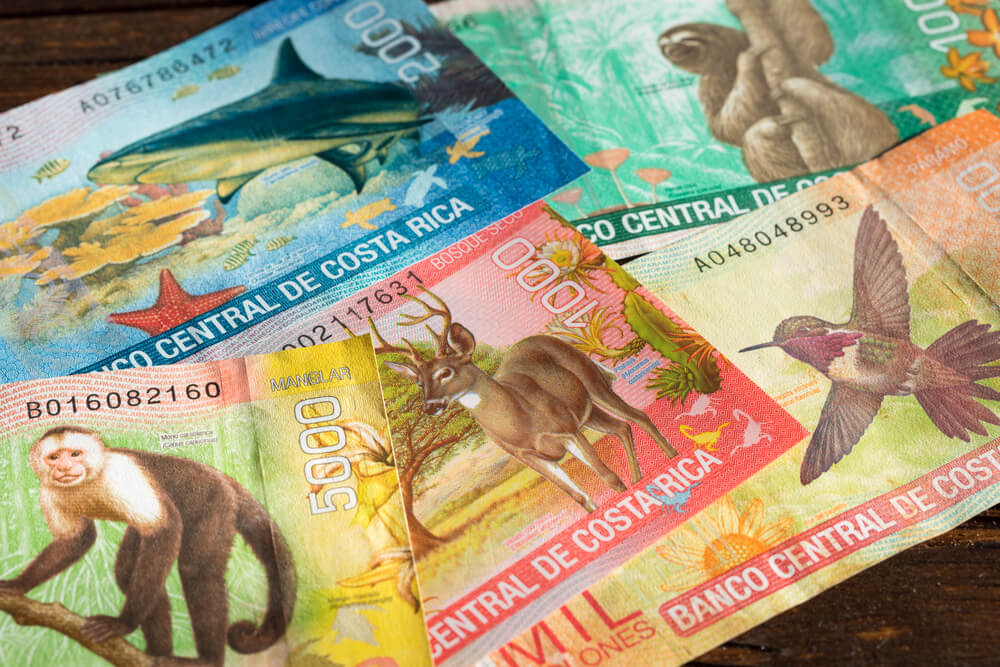
Each denomination represents an ecosystem found across the country. And within each one, specific species bring that environment to life,not as decoration, but as a reflection of the place they belong to.
The ₡1,000 colones bill represents the tropical dry forest, located mainly in Guanacaste and the northern Pacific lowlands.
This ecosystem is defined by contrast.
During the dry season, trees lose their leaves, and wildlife adapts to limited water. The landscape feels quiet, almost paused.
Then the rains arrive and everything changes.
The forest turns green again, and life returns with intensity.
The presence of the white-tailed deer reflects that constant adaptation. It is a species that moves with the rhythm of the seasons, adjusting to both scarcity and abundance.
The ₡2,000 colones bill represents the coral reef ecosystem, a world that exists beneath the surface.
These ecosystems develop in warm, clear, shallow waters, where sunlight allows life to thrive.
Coral reefs are complex and vibrant, often described as underwater gardens.
Here, both the shark and the sea turtle appear, representing movement, balance, and life within this marine environment.
The ₡5,000 colones bill represents the mangrove ecosystem, where land and sea meet.
Mangroves grow along coastal areas, especially near river mouths, where saltwater and freshwater mix. Their roots create shelter and serve as nurseries for many species.
The presence of a monkey and a crocodile reflects the diversity of life that depends on this environment, both above and below the water.
It is a place of transition, and of beginnings.
The ₡10,000 colones bill represents the tropical rainforest, one of the most recognizable ecosystems in Costa Rica.
Dense, humid, and layered, it is a place where life exists at every level.
From the forest floor to the canopy, species occupy different spaces, creating an intricate network of life.
The presence of the sloth reflects the slower, balanced rhythm of this environment, while the orchids highlight the richness and diversity of plant life.
The ₡20,000 colones bill represents the páramo, a high-altitude ecosystem found above 2,800 meters.
This environment is open, cold, and often covered in mist. Conditions are extreme, and life here requires adaptation.
The presence of a hummingbird and a rabbit reflects the species that have adapted to survive in this landscape, where temperatures shift quickly and vegetation remains low.
Together, these five bills create something more than individual representations.
They form a journey across Costa Rica.
From dry forests shaped by seasons
To coral ecosystems beneath the sea
To coastal mangroves
To dense rainforests
To high mountain landscapes
Each one connected through the species that inhabit them.
While the bills present complete ecosystems, the coins follow a quieter path.
They simplify the idea.
They focus on a single species.
The ₡50 colones: ecosystems in their simplest form
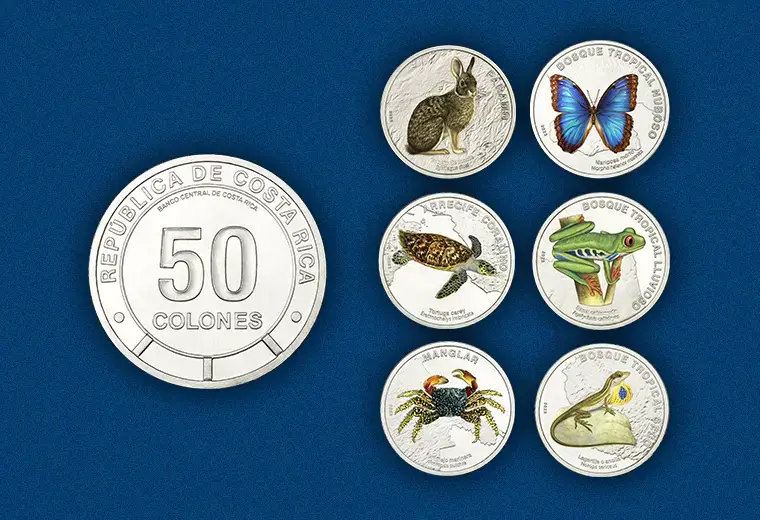
Among Costa Rica’s coins, the ₡50 colones stand out.
It features six different designs, each representing an ecosystem through one animal:
Each coin reduces an entire ecosystem into a single, recognizable element.
One species that represents a much larger environment.
What makes this system so interesting is how both formats work together.
The coins introduce the idea in its simplest form.
The bills expand it into complete ecosystems.
From a single species to an entire environment, the message remains consistent.
Nature is not an addition.
It is part of identity.
At GoNat, we believe that meaningful experiences don’t always begin in distant places.
Sometimes, they begin with attention.
Costa Rica’s bills and coins are part of everyday life, familiar, constant, and often overlooked.
But within them, there is a story.
One of ecosystems, species, and identity.
And sometimes, all it takes is a closer look to see it.

©2024 - 2026 GoNat Tour Operator, by Luzk. Todos los Derechos Reservados