
Water is essential to every forest. But what happens when moisture becomes so abundant that life must adapt to having almost too much of it?
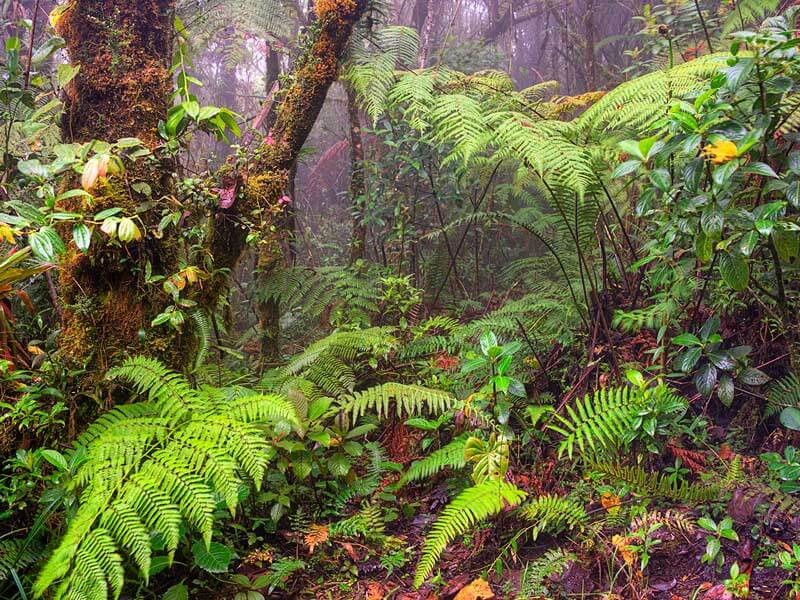
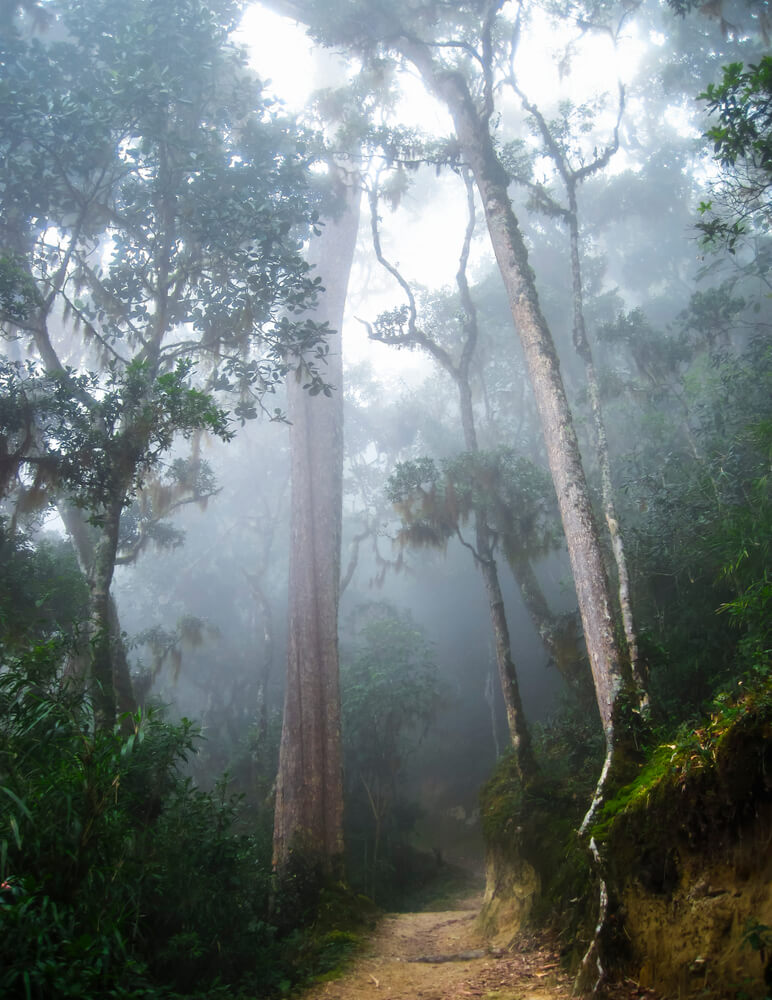
High in Costa Rica’s mountains, there is a forest shaped by this unusual reality. Rainfall is frequent, temperatures remain low, soils stay wet for long periods, and clouds can envelop the landscape with little warning. Instead of the warmth and explosive growth associated with tropical lowlands, nature here follows a slower and more demanding rhythm.
This is the Montane Rain Forest, or Bosque Pluvial Montano—one of Costa Rica’s most distinctive high-elevation life zones.
Found primarily in the country’s highest mountain systems, this ecosystem proves that abundance does not always mean ease. Water is everywhere, yet the combination of cold, persistent humidity, altitude, and rugged terrain creates conditions that challenge plants, animals, and even human activity.
Life thrives here, but it does so on the mountain’s terms.
The word “tropical” usually brings images of heat, palms, and warm humid air.
At these elevations, those expectations disappear.
The Montane Rain Forest occurs in areas where average biotemperatures can range roughly between 6°C and 12°C. Rainfall is considerable, often reaching several thousand millimeters annually, while cloud cover and high humidity reinforce the cool conditions.
The combination changes how the ecosystem functions.
Evaporation is slower than in warmer forests, organic material can remain wet for extended periods, and the biological processes taking place in the soil respond to much lower temperatures.
For humans, these same conditions can be challenging. Cold humidity, steep terrain, and high precipitation make many areas poorly suited to intensive agriculture, forestry, or permanent settlements.
What appears beautifully lush to a visitor can actually be an extremely demanding environment.
Plants cannot escape the climate around them, so they adapt.
One of the most characteristic features of vegetation in the Montane Rain Forest is the prevalence of coriaceous leaves—thick, firm leaves with a somewhat leathery texture.
This structure helps plants cope with the environmental conditions of high mountains, where moisture, wind, cool temperatures, and exposure can place considerable stress on vegetation.
The forests themselves remain evergreen and are generally lower than the great forests of Costa Rica’s tropical lowlands. Trees commonly form compact stands rather than extraordinarily tall canopies.
And beneath them, another plant becomes particularly noticeable.
Bamboo may evoke images of Asia, but Costa Rica has its own native mountain bamboos.
Species of Chusquea are characteristic components of high-elevation vegetation and can form dense patches beneath or alongside the forest canopy.
Unlike the towering woody bamboo many travelers imagine, these native species are part of the natural ecology of Costa Rica’s mountains. Their dense growth provides cover for small animals, influences the structure of the understory, and creates an entirely different visual character from forests at lower elevations.
Walking through an area dominated by Chusquea can feel surprisingly different. The vegetation becomes tighter and more enclosed, creating sheltered spaces beneath a landscape exposed to mountain weather.
It is one of those details that reveals just how dramatically Costa Rica can change within only a few hours of travel.
Cold and moisture influence animals as much as plants.
Rather than supporting the enormous variety of heat-loving organisms associated with the lowlands, these mountains favor species capable of functioning under cooler and often highly variable conditions.
Birds move between forest levels searching for fruits, seeds, and insects. Small mammals use dense vegetation as protection, while amphibians take advantage of moist microhabitats hidden beneath leaves, logs, and rocks.
But some of the most important inhabitants are nearly invisible.
Fungi, microorganisms, and soil organisms are responsible for breaking down fallen vegetation and returning nutrients to the ecosystem. Because temperature influences decomposition, these processes can behave differently here than in Costa Rica’s warm tropical forests.
A fallen branch is therefore more than debris. It becomes part of a slow biological cycle in which nutrients are stored, transformed, and eventually returned to new life.
The Montane Rain Forest is strongly associated with Costa Rica’s highest mountain systems, particularly the Cordillera de Talamanca, where extensive highland landscapes provide the climatic conditions this ecosystem requires.
Rather than thinking of one national park as representing the entire life zone, it is useful to imagine the Talamanca range as a mosaic. Elevation, rainfall, slope orientation, and local climate allow different life zones to exist relatively close to one another.
Protected landscapes such as Chirripó National Park and the vast La Amistad International Park help conserve portions of this high-mountain environment and the ecological connections surrounding it.
But Talamanca is not its only home.
Smaller areas of Montane Rain Forest also occur around high summits of Costa Rica’s Central Volcanic Range, including mountainous environments associated with Irazú, Turrialba, Barva, and Poás. This fragmented distribution demonstrates how strongly the life zone depends on a particular combination of elevation and climate.
In Irazú Volcano National Park, for example, Montane Rain Forest represents an important part of the protected landscape, alongside other high-elevation vegetation communities.
Much of the Montane Rain Forest occurs in terrain that has historically been difficult to access or develop.
What once made these mountains challenging for people has also helped protect them.
Large highland forests provide habitat for specialized species, preserve natural mountain soils, store carbon in vegetation and organic matter, and maintain ecological connections across different elevations.
Their relative isolation also makes them valuable natural laboratories.
Scientists can study how tropical ecosystems respond to cold conditions, how species distributions change with altitude, and how mountain vegetation reacts to shifts in temperature and precipitation.
In an era of climate change, those questions are becoming increasingly important.
Mountain species face a geographical problem that lowland organisms do not: there is only so much mountain above them.
If temperatures change significantly, species adapted to narrow climatic ranges may shift toward higher elevations in search of suitable conditions. Eventually, however, the available landscape becomes smaller.
That makes protecting continuous mountain habitat particularly important.
Conservation in these environments is not simply about preserving individual forest patches. It is about maintaining enough connected landscape for ecological communities to respond naturally to future changes.
Costa Rica’s extensive network of highland protected areas provides an important foundation for that effort.
The Montane Rain Forest challenges one of our simplest ideas about nature: that more water must always make life easier.
Here, abundance creates its own obstacles.
Plants develop strategies for surviving cold, saturated environments. Bamboo claims spaces beneath the canopy. Biological processes slow and adjust. Human activities become increasingly difficult.
Yet the forest persists.
For travelers exploring Costa Rica’s highlands, understanding this ecosystem adds another dimension to the landscape. What first appears to be simply another green mountain forest becomes evidence of something far more fascinating—a community of life shaped by conditions that demand specialization at every level.
The Montane Rain Forest does not thrive because its environment is easy.
It thrives because, over time, life has learned exactly how to belong there.
©2024 - 2026 GoNat Tour Operator, by Luzk. All Right Reserved